Permitting


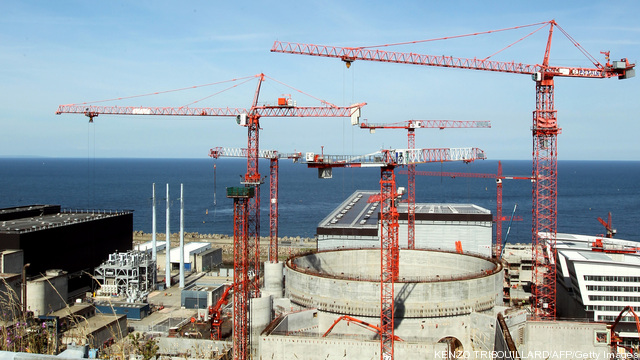
The US federal government has set aside more than a quarter of a billion dollars to fund the demonstration of a small modular (SMR) nuclear reactor in the US, with potential total funding rising to close to half a billion dollars. With smaller-scale nuclear technology widely discussed as the future of the troubled sector, a whos-who of companies are expected to participate in the project and apply for the funds.

Westinghouse Electric Company, based in Pittsburgh but part of Japan’s Toshiba, has submitted a letter of intent saying it will compete for the SMR nuclear deployment acceleration grant. The company is showcasing a 225 MW-equivalent integral pressurized water reactor that leverages technology from its already-licensed AP1000 nuclear power plant design. Keep reading →


Even with well-established forms of energy development like oil and gas, the science on impacts to the environment can be hard to quantify and harder to predict. The challenge for sectors like the wind industry – comparatively new in its current form – are even higher given the lack of operational data, but as in other areas, the wind business is sprinting to get ahead.

A number of wind energy industry leaders joined several years ago with major environmental groups to form the American Wind Wildlife Institute, which plays several roles but represents an early effort by the sector to be certain wind energy development remains attractive while assuaging or minimizing concerns about impacts on wildlife. Keep reading →


Offshore wind energy has been challenging to develop in the US despite significant promise and comparative access on the East Coast to major load centers. Finding financing is a perennial challenge for renewable energy projects of all kinds, making Cape Wind‘s recent announcement it had finalized an agreement with Bank of Tokyo-Mitsubishi UFJ to lead its commercial bank financing marks a more significant step in developing the planned 468 MW wind farm than it at first appears.

Barclays remains the project’s financial advisor, and Ted Roosevelt IV, the managing director there, called the agreement with the Japanese bank a “significant step toward achieving financial close.” Keep reading →


Wind farms have been accused of killing hosts of birds that get caught in their turbines, accusations that have failed to slow the proliferation of wind energy installations across the country, but killing an eagle is a different matter.

The US Fish and Wildlife Service is investigating the death of a golden eagle at a wind farm in Kern County, California, and is asking for local resident’s help. Keep reading →


The past year has proved a fundamental pivot in North American energy markets, and set the stage for the coming years to look very different from the past four decades of US energy industry history.

I’ve reviewed the ways the changes that originated in 2012 will affect the political scene in the US here, but in looking through our most popular and most compelling posts on Breaking Energy in the last year I noted how many of them supercede easy categorization. Stories about fracking cut across the buckets in which we seek to put our daily dose of energy news, analysis and discussion, but so have stories about the wind industry, financial shifts and smart grid technology. Keep reading →


Does anyone use the term eco-terrorists any more? Since Greenpeace stopped tying themselves to power plant smokestacks on a regular basis and global economic leaders decided they’d rather deal with the financial crisis than with climate change, the mood among those who advocate for environmental rules has evolved to one of public education and consensus-seeking.

That doesn’t mean that natural gas magnates should rest easy though, or at least that’s what the people traditionally charged with evaluating the manifold security risks for energy companies operating in harsh environments are arguing. Keep reading →

It is difficult to exaggerate the scale of the changes that the burgeoning natural gas and oil production in the US are setting in motion, so some numbers help set the tone. Numbers like $50 million a mile, and $70 billion a year.

Those are two of the figures cited by Manhattan Institute senior fellow Robert Bryce, who writes about and studies the energy sector for the think tank. Breaking Energy spoke with him at the US Association for Energy Economics conference in Austin, Texas in November, and he detailed some of the opportunities and the challenges for the natural gas sector. Keep reading →


The question of natural resource ownership has been answered in many different ways over the course of human history, with compromises between the interests of societies and individual developers taking on a variety of forms.

While it often seems that the basic parameters of ownership and regulation of ownership have been sorted out in places like the US, comparatively small evolutions in the perception of these relationships can have outsized impacts on specific energy projects or companies. Keep reading →


Estimates vary widely on its cost, but it’s thought the Three Gorges Dam is the most expensive hydroelectric project ever built.

Ocean Power Technologies has gained approval from the Federal Energy Regulatory Commission for the complete build-out of its wave power station off the southern Oregon Coast, the first wave power station to be licensed in the U.S.

FERC granted a 35-year license for the wave power station to OPT subsidiary Reedsport OPT Wave Park, LLC. OPT said in a news release that construction of the first PowerBuoy® is almost completed and should be deployed 2.5 miles off the Reedsport coast later this year. After the first buoy is deployed, OPT will build up to 9 additional buoys and their grid connection infrastructure – assuming additional funding and the remaining regulatory approvals are obtained. Keep reading →

Page 1 of 1212345...12