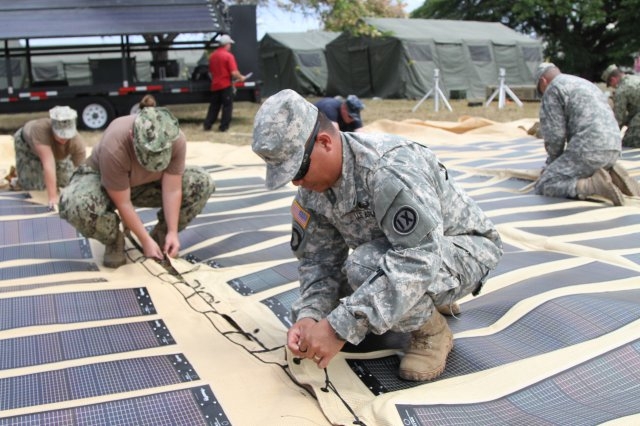
The US warfighter of today is wired. And batteries have to be included.
Enter SWIPES. Keep reading →

The US warfighter of today is wired. And batteries have to be included.
Enter SWIPES. Keep reading →
US President Barack Obama (L) and Senate Majority Leader Harry Reid (R) tour Photovoltaic Array at Nellis Air Force Base in Las Vegas, Nevada, May 27, 2009 with Base Commander Colonel Howard Belote.
The US military services want to derive 3 gigawatts of electric capacity from renewables by 2025, but they don’t have the budget to pay to build it. Keep reading →
According to researchers at the U.S. Naval Research Laboratory (NRL), one of the Marine Corps’ most significant challenges is finding a way to provide reliable electricity to soldiers in forward operating bases. Like the rest of us, the U.S. military is desperate for ways to reduce its fuel and battery consumption. It’s widely recognized that solar panels are one of the only technologies that can provide a portable, affordable source of power to those on the front lines. Keep reading →

No one ever said training for battle was easy, nor energy-efficient. The “Battle Lab” is a U.S. military facility in New Jersey where more than 20,000 soldiers prepare and train for battle. The lab includes shooting ranges, vehicle rollover trainers and other high-tech simulators. But those high-tech tools suck up millions of kilowatts of power.
Now, more than a quarter of the training facility’s power is being provided by renewable energy sources. The Army Corps of Engineers along with the help of contractor P & S Construction helped complete a solar power project onsite at Joint Base McGuire-Dix-Lakehurst. Photovoltaic solar panels were mounted to the roof of the Battle Lab, covering approximately 71,000 square feet. Keep reading →

What’s big, green and set to save taxpayers money over the course of the next 30 years? A new 3.4 megawatt (MW) solar power installation at Edwards Air Force Base in Southern California, that’s what. Comprising three ground-mounted, single-axis tracking solar farms, the system was built and is owned by Borrego Solar, which will sell power to the military base under the terms of an in-house power purchase agreement (PPA).
“Our utility bill can range anywhere from $15 million to $18 million a year and our utility bills for the summer actually double, but our consumption only goes up 3 percent,” said James Judkins, 95th Civil Engineering director, Edwards Air Force Base, in a statement. “What we’re trying to do (with this project) is not so much conserve energy, but save money.” Keep reading →

Much like microwaves and satellites, the US military could serve as an incubator for hydrogen fuel cell vehicle technology, helping it advance to a point where it can stand on its own in the global marketplace. In one of the latest examples of the private sector collaborating with the military on new technologies, General Motors and the U.S. Army, Pacific recently launched a 16 hydrogen fuel cell vehicle fleet in Hawaii.
The US Army views this as a worthwhile investment because its desire to reduce fossil fuel reliance, which can be a security concern. The contract is for a fleet of administrative vehicles that will be driven on base and around Oahu. Keep reading →

The Navy’s push to become a more environmentally-friendly fighting force took a beating on Capitol Hill last week. But the tongue lashing delivered by House defense lawmakers has little chance of gaining traction on the Hill or inside the Pentagon, analysts say. House Armed Services Seapower subcommittee member Randy Forbes took Navy Secretary Ray Mabus to task, slamming the service’s continued investment in alternative fuels, one of Mabus’ top priorities for the service. “I understand that alternative fuels may help our guys in the field, but wouldn’t you agree that the thing they’d be more concerned about is having more ships, more planes, more prepositioned stocks,” Forbes said during the Friday hearing. “Shouldn’t we refocus our priorities and make those things our priorities instead of advancing a biofuels market?”
A man stands in front of a windmill exhibit inside the Andrew Mellon Auditorium that is filled with an internactive and computer-operated show floor and stage for GE’s four-day event ‘American Competitiveness: What Works,’ February 13, 2012 in Washington, DC. As part of its ‘Hire Our Heroes’ program, General Electric says it will hire 5,000 veterans over the next five years and invest $580 million to expand its aviation business.
Faced with a need to fill more than 100,000 skilled jobs over the next eight years, US energy companies are working to attract veterans returning from Iraq and Afghanistan with the experience needed in an industry that needs a large-scale upgrade in its infrastructure. Keep reading →

As the United States continues attempting to wean itself off of foreign oil, the Department of Energy has been increasingly supporting alternative technologies.
Among the efforts has been the DOE’s support of ClearFuels-Rentech’s pilot-scale biorefinery in Commerce City, Colorado. Keep reading →

Oil is a global commodity–it is easy and cheap to ship it around the world. That means that the security of its distribution network is just as important as the security of its supply. This distribution network–including port terminals, huge oil supertankers, and lengthy pipelines–is vast and costly. It is also vulnerable to conflict, piracy and terrorism.
About one fifth of America’s oil imports come from the Persian Gulf, passing through the Strait of Hormuz as it is shipped to our shores. Over 15 million barrels of oil per day pass through the Strait, a 21 mile-wide body of water vulnerable to Iranian anti-ship missiles. Iran has repeated its threats to close the Strait and is well positioned to carry out attacks on oil tankers in transit. The very threat of closing the Strait of Hormuz to shipping is enough to give the Iranian regime more leverage in the region than they are due. Keep reading →